
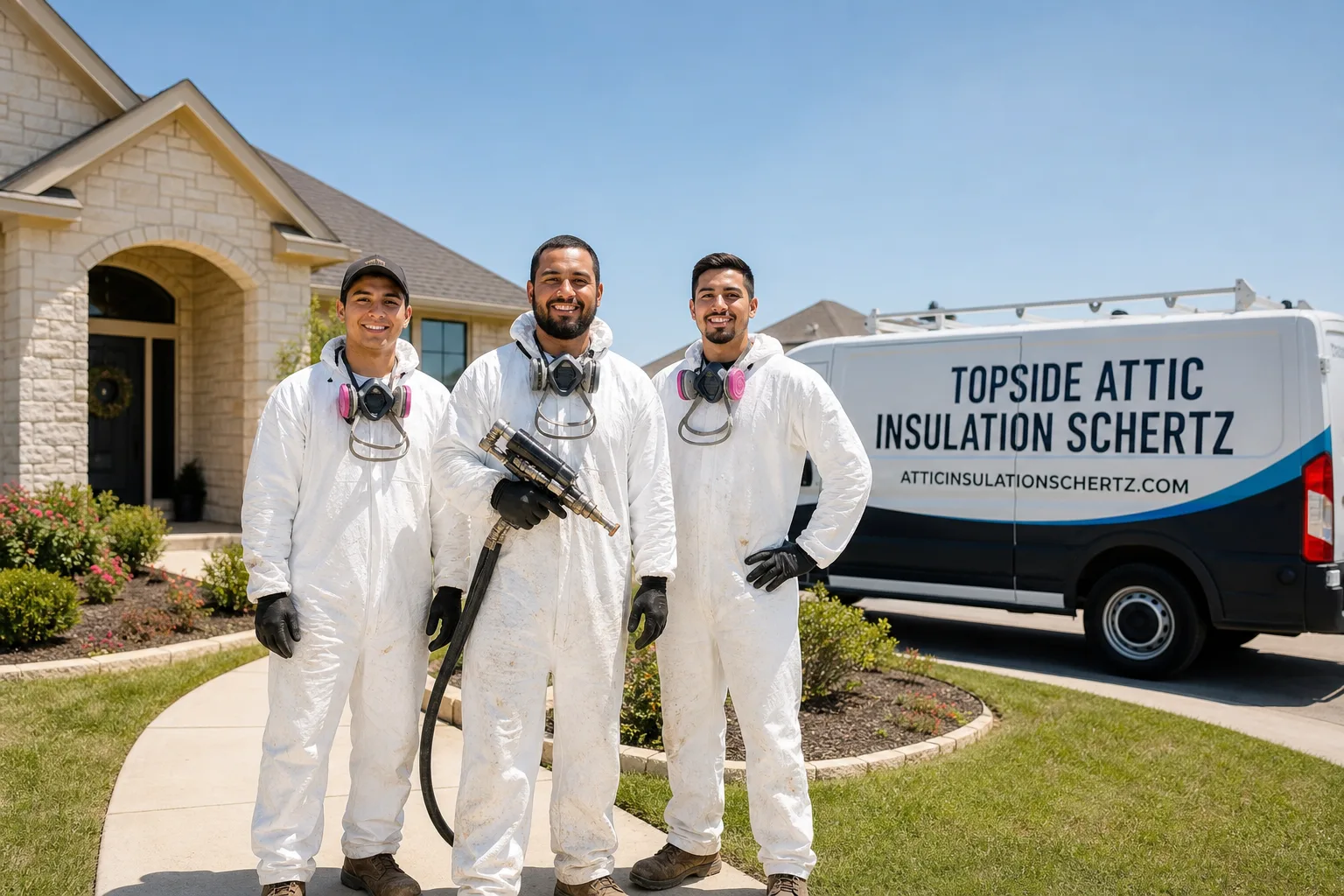
How Much Does Attic Insulation Cost in Schertz?
Attic Insulation Near Me in Schertz, TX typically runs between $1,400 and $3,800 for a standard single-story home, with most projects landing around $2,100 when blown-in fiberglass or cellulose is installed over a properly air-sealed attic floor. Homes in the 2,000-2,800 sq ft range – which covers a large share of the subdivisions between FM 1518 and Schertz Parkway – tend to fall in the $1,800-$2,600 window, assuming no prior insulation removal is needed and the attic floor penetrations are sealed before the insulation goes in.
At Envelope Insulation Co., operating as Topside Attic Insulation Schertz, we publish a written price before any work starts – no callbacks, no “we’ll let you know after we get up there.” If you want a number before we arrive, this guide gives you the market range. When you’re ready for a number specific to your home’s square footage, attic depth, and current R-value, call (830) 402-5240 – estimates are free and the price you receive is flat and in writing.
Attic Insulation Cost Breakdown for Schertz (2026)
The table below reflects what homeowners in Schertz and the broader Guadalupe County area are actually paying in 2026. Prices account for material costs, labor, equipment, and a standard attic air-sealing pass before insulation is added – because at Envelope Insulation Co., air sealing of top plates, can lights, and penetrations is completed before any insulation is blown in. That step is not an upsell; it’s a prerequisite.
| Service / Material | Typical Price Range (Schertz Market) | Notes |
|---|---|---|
| Blown-in fiberglass (attic floor, to R-38) | $0.85-$1.10 per sq ft | Most common install in Schertz-area new resales (2015-2022 builds) |
| Blown-in fiberglass (attic floor, to R-49) | $1.05-$1.35 per sq ft | Recommended for homes with high HVAC runtime in the TX Hill Country heat corridor |
| Blown-in cellulose (attic floor, to R-38) | $0.80-$1.05 per sq ft | Good air-resistance properties; sourced from GreenFiber or Knauf |
| Blown-in cellulose (attic floor, to R-49) | $1.00-$1.30 per sq ft | Popular in older Schertz homes (pre-2000) where R-values are low |
| Spray foam – open-cell (roof deck / encapsulated attic) | $1.80-$2.50 per sq ft | Typically used when HVAC equipment lives in the attic; Icynene or Demilec |
| Spray foam – closed-cell (roof deck) | $3.00-$4.25 per sq ft | Highest air and moisture resistance; less common in Schertz residential |
| Attic air sealing (top plates, penetrations, can lights) | $300-$650 standalone | Included as a prerequisite when Envelope Insulation Co. installs insulation |
| Existing insulation removal | $0.50-$1.00 per sq ft | Required when old fiberglass is contaminated, compressed, or rodent-damaged |
| Radiant barrier installation (attic floor or roof deck) | $0.40-$0.75 per sq ft | Meaningful in Schertz summers; reduces radiant heat gain through the roof deck |
| Whole-project range (typical 2,000-2,800 sq ft Schertz home) | $1,400-$3,800 | Air sealing + blown-in insulation to R-49 with documented photo record included |
What Makes a Project Land at the High or Low End?
A 1,600 sq ft single-story home in Schertz Farms with a simple rectangular attic floor, no recessed can lights, and four inches of existing fiberglass still in place will come in near the low end – often $1,400-$1,700 for air sealing plus an Attic Insulation Top-Up to R-49. A 2,800 sq ft two-story home in Kensington Ranch with a complicated hip roof, 22 recessed can lights, spray foam around the HVAC platform, and old batt insulation that needs to come out first can push $3,200-$3,800 before a radiant barrier is factored in.
The single biggest swing factor in Schertz is whether insulation removal is required. We see a lot of attics in the FM 3009 corridor and the older sections of Schertz near IH-35 where the original blown-in has settled to an R-8 or R-10 – well below the R-38 minimum the Department of Energy recommends for Climate Zone 2, which covers all of Guadalupe County. If removal isn’t needed, costs drop significantly. If the existing material is contaminated or compacted past the point of effective performance, Attic Insulation Replacement is the right call and we’ll say so in writing before a single bag of new material goes up.
What Affects Attic Insulation Pricing in Schertz
- Attic square footage and geometry. A straightforward rectangular attic floor is faster to seal and insulate than a complicated roofline with multiple valleys, knee walls, or cathedral sections. Many homes in the Heartland subdivision and newer developments off Live Oak Road have complex roof geometries that add labor time and affect the final price.
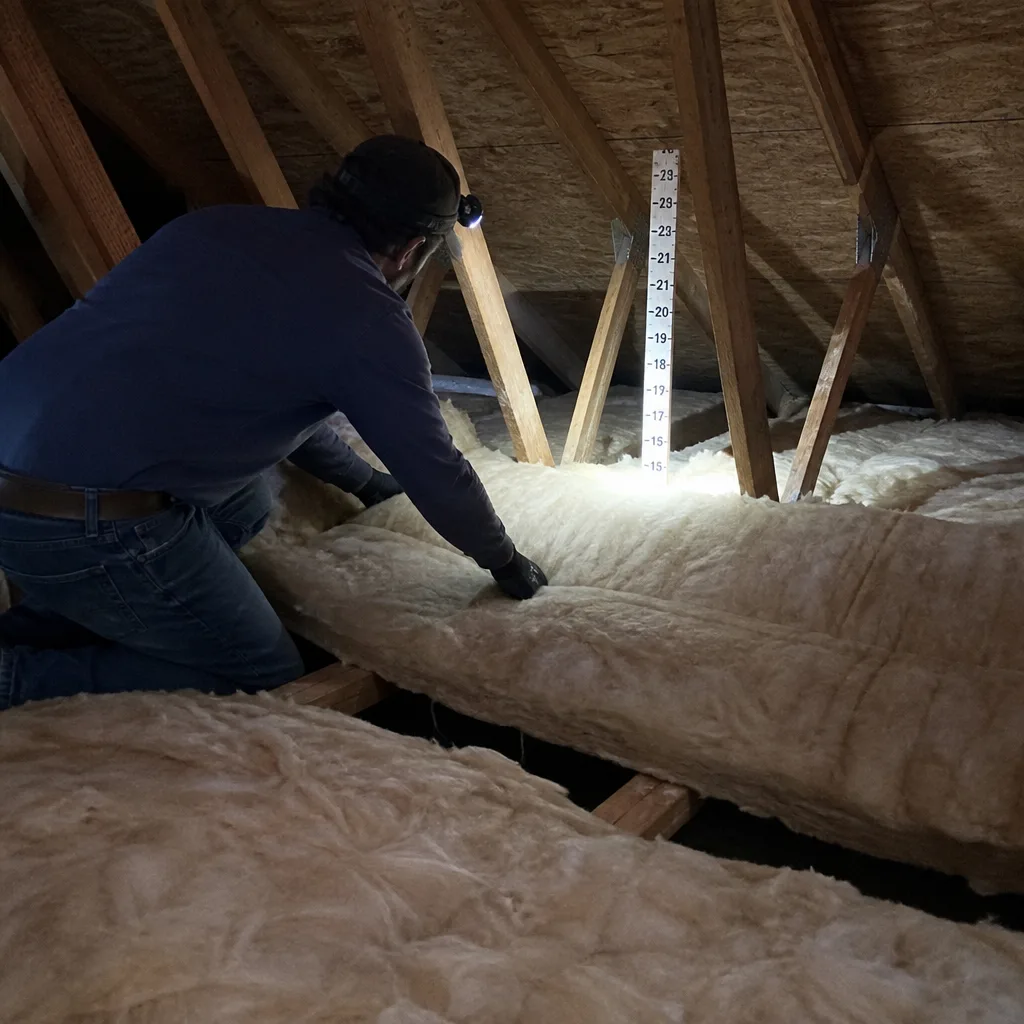
- Current R-value and condition. Schertz’s Climate Zone 2 designation puts the minimum recommended R-value at R-38, with R-49 being the better target given summer attic temperatures that regularly hit 145-155°F from June through September. Homes with R-11 or less require more material. Homes with damaged or rodent-contaminated insulation require removal first, which adds both cost and time.
- Air sealing complexity. The number of recessed can lights, top-plate penetrations, HVAC boots, and plumbing chases that need to be sealed before insulation goes in directly affects labor time. A Schertz home built between 1995 and 2008 – common in the Savannah Heights and Northcliffe areas – often has 15-30 unsealed can lights that each need a fire-rated air dam before any blown-in material goes over them. Skipping this step (as many contractors do) leaves a direct pathway for conditioned air to escape into the attic.
- Material choice. Blown-in fiberglass (Owens Corning or Johns Manville), blown-in cellulose (GreenFiber or Knauf), and spray foam (Icynene or Demilec) each have different installed costs and performance profiles. Spray foam on the roof deck creates an encapsulated attic – useful when HVAC equipment sits in the attic space, which is common in one-story slab-on-grade construction throughout Schertz – but it costs roughly twice what a floor-level blown-in job costs.
- Access and attic height. Low-pitch attics – under a 4/12 roof slope, common in some Schertz ranch-style homes – limit how far a technician can move in the attic and can add labor time. Attics with a single small hatch instead of a pull-down stair also slow the job.
- Add-on services: radiant barrier, attic cleaning, and home energy audit. A reflective radiant barrier stapled to the underside of the roof deck can cut radiant heat gain by 25-40% in a Schertz summer – a meaningful number when the roof deck faces southwest. Attic cleaning, rodent proofing, and a full home energy audit (including a blower-door test that documents CFM50 before and after sealing) each add to the project total but also add to the documented performance record the homeowner receives.
Local Schertz Context: Why Attic Performance Matters More Here Than in Milder Markets
Schertz sits in Bexar and Guadalupe Counties at the southern edge of the Texas Hill Country heat corridor. Summers run long – mid-May through early October is a realistic window for triple-digit heat index days – and the attic becomes the single largest thermal load on the home’s HVAC system during those months. An under-insulated attic in Schertz isn’t a comfort footnote; it’s a mechanical problem. We regularly document attic temperatures above 150°F on south-facing roof decks in July, and a 4-inch layer of settled fiberglass (R-13 at best) barely slows that heat down before it reaches the ceiling drywall.
The homes most affected tend to be in the older sections of Schertz near FM 78 and IH-35 – builds from the 1980s and 1990s where original insulation was installed to the then-code minimum of R-19 and has since settled further. Newer construction in Crossvine, Crescent Bluff, and the Homestead Trails area typically comes with builder-grade R-30 to R-38, which meets code but leaves headroom for improvement, particularly if air sealing wasn’t completed before the insulation was blown in – which, in our experience, it often wasn’t.
One more Schertz-specific factor: CPS Energy (the primary utility serving much of the greater San Antonio region, including many Schertz homes) periodically offers rebates for qualifying insulation upgrades. The rebate structure changes from year to year, so we don’t quote a specific number here, but it’s worth checking current CPS Energy program offers before your project starts – a qualified upgrade can meaningfully reduce your net cost, and we can tell you whether your planned scope qualifies.
How to Save on Attic Insulation in Schertz
1. Start with an accurate R-value assessment – not a guess.
Some homeowners are quoted for a full R-49 install when their existing insulation is already at R-22 and in good condition. A proper assessment – the kind that includes a measurement, not an eyeball estimate – means you pay for what you actually need. Our written scope tells you the existing R-value we measured, the target R-value, and exactly how many inches of material will be added to get there.
2. Air seal before you insulate – don’t pay to insulate twice.
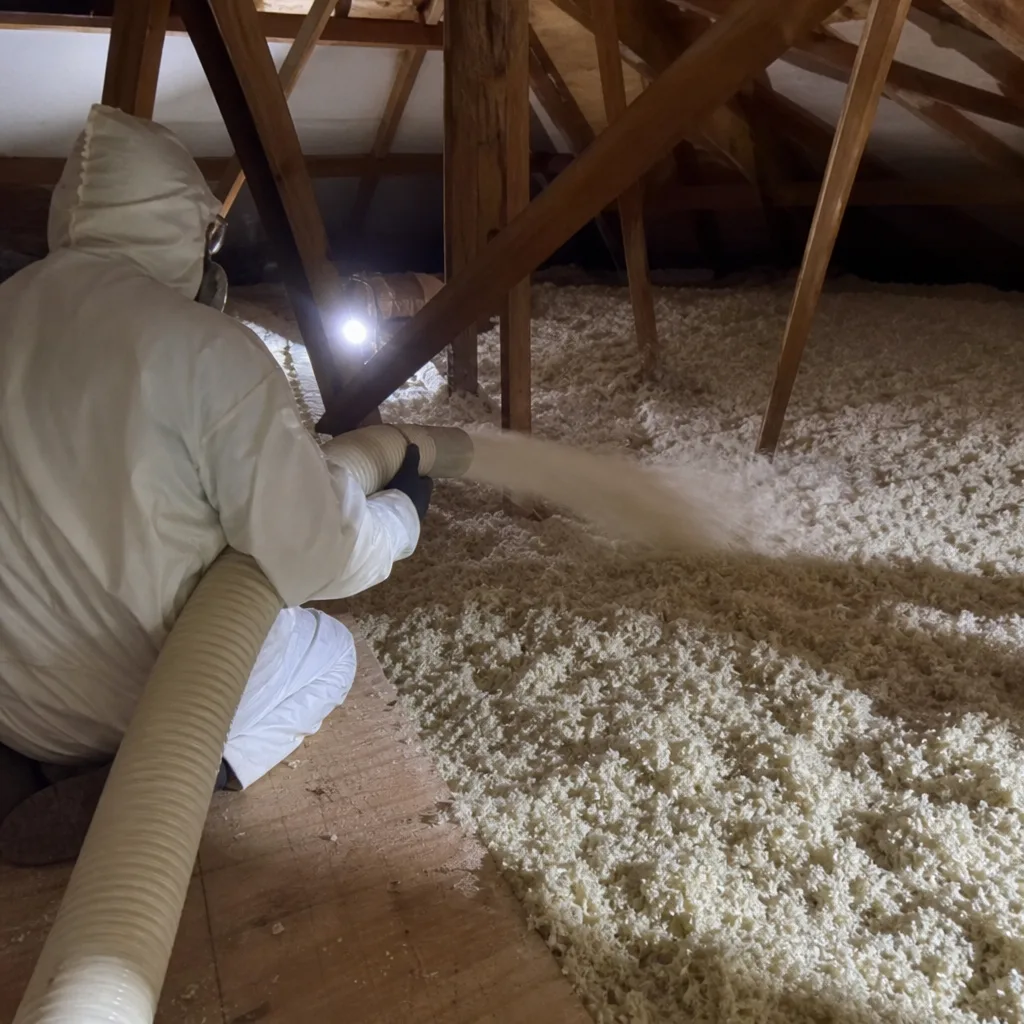
Adding insulation over an unsealed attic floor is like filling a bathtub with the drain open. The insulation slows conductive heat transfer, but conditioned air is still escaping through every gap around light fixtures, plumbing penetrations, and top plates. The result is a homeowner who pays for R-49 insulation and still sees a high energy bill. At Envelope Insulation Co., air sealing happens first – always – and the blower-door reading before and after documents the difference in a single measurable number, so you can see exactly what the sealing step delivered.
3. Bundle services when the attic is already open.
If you’re scheduling attic insulation, adding a radiant barrier or attic cleaning during the same visit costs less than a separate mobilization later. Labor and equipment setup are already priced into the job; adding square footage or a complementary service at that point is more efficient than a second appointment.
4. Get a second opinion on any written estimate.
Under the Haven Standard, we offer a free second opinion on any competing written estimate. Bring us a quote from another contractor and we’ll read it with you – line by line – and tell you what’s in it, what’s missing, and how our scope compares. This isn’t a sales tactic; it’s how you make a confident decision. Call (830) 402-5240 to schedule that review – it costs you nothing.
5. Check utility rebate programs before signing anything.
CPS Energy rebates for insulation upgrades have been available in various forms since at least 2019. The qualifying R-value thresholds and rebate amounts shift periodically, but a qualifying blown-in upgrade can knock $150-$400 off your net project cost. Confirm the current program terms directly with CPS Energy or ask us to walk you through what we know at the time of your estimate.
6. Don’t over-specify when blown-in fiberglass does the job.
Spray foam on the attic floor is almost never the right answer for a Schertz home with a vented attic and no HVAC equipment in the attic space. It’s 2-3x the cost of blown-in fiberglass or cellulose for an application where those materials perform nearly as well. Closed-cell spray foam earns its premium on roof decks in encapsulated-attic configurations or in crawl spaces – not on a vented attic floor where a properly sealed and insulated blown-in job delivers the same thermal result.
What You Receive at the End of Every Job
This is the part most contractors don’t talk about because most contractors don’t do it. At Envelope Insulation Co., every completed job closes with the same documented record:
- A Documented Photo Record of the attic floor before and after – showing existing conditions, air sealing work completed, and final insulation depth at multiple measurement points.
- On applicable jobs, before-and-after blower-door readings – a pressurization test that produces a CFM50 figure, which shows in one number how much conditioned air the building envelope was losing before the work and after. If the sealing step improved your home’s air tightness, you’ll have the numbers to prove it.
- A written scope and written warranty delivered before the job starts, not after – Haven Standard Clause 1: flat price, written scope, written warranty before anyone lifts a tool.
- The 365-Day Done Right Promise: if something isn’t right within the first year, we make it right. That’s in writing too.
The technicians who show up are background-checked and uniformed. You’ll receive a text when they’re on the way, with the technician’s name included. Calls are answered by a live person – no voicemail loops, no callback windows measured in business days.
Envelope Insulation Co. vs. the Typical Schertz Contractor
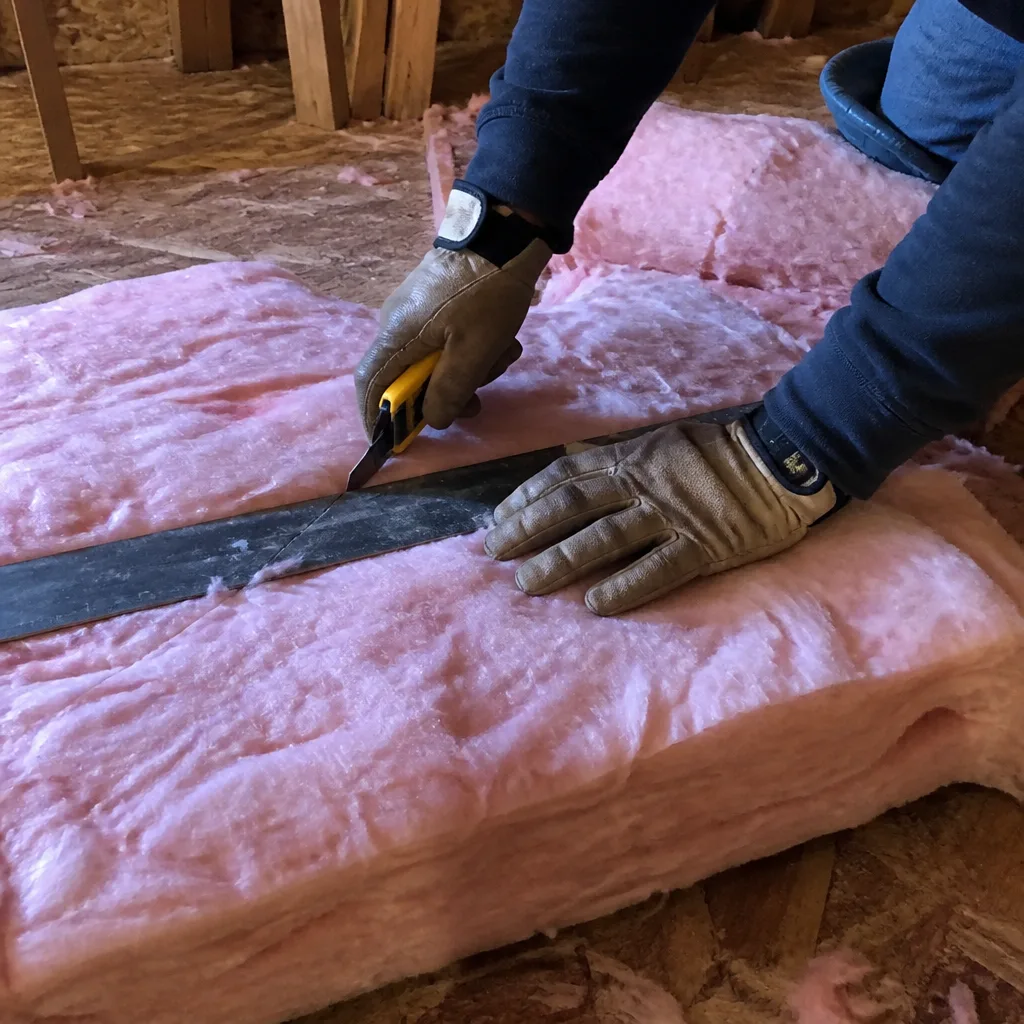
There are a handful of insulation contractors working the Schertz and greater San Antonio area. Most of them will give you a number over the phone, send a crew, and blow insulation in. Some of them will do a reasonable job. The differences that matter:
- Most contractors blow insulation over an unsealed attic floor. We seal first. The performance difference is documented with a blower-door test.
- Most contractors give you a verbal quote or a number on a Post-it. We give you a written price with a written scope before work starts, every time.
- Most contractors move on when the job is done. We close the job with a photo record and, on applicable projects, a before-and-after blower-door reading you can use to verify what you paid for.
- Most contractors offer a one-year labor warranty. Our 365-Day Done Right Promise is in writing and covers the full scope of the completed work.
Since 2016, Wes Okafor has led Envelope Insulation Co. with a single operating rule: the documentation the homeowner receives when we leave should be better than anything any other contractor in this market produces. Over 9,000 homes sealed and insulated, every one with a written price before work started and a documented record when the crew left.
That’s not a marketing line. It’s what Haven Standard means in practice – and it’s what separates a company that talks about quality from one that documents it.
If you want to see what that documentation looks like for a Schertz attic insulation project, explore our full service offering on the Attic Insulation in Schertz page, or start at the home page to see the complete building-envelope service line.
FAQs – Attic Insulation Cost in Schertz, TX
How much does attic insulation cost in Schertz in 2026?
Most our Attic Insulation services projects in Schertz run between $1,400 and $3,800, with the majority of 2,000-2,800 sq ft single-story homes landing in the $1,800-$2,600 range when blown-in insulation is installed to R-49 over a properly air-sealed attic floor. Smaller homes or simpler attic configurations can come in under $1,500. Projects that include insulation removal, spray foam, or radiant barrier work push toward the higher end. Call (830) 402-5240 for a written estimate specific to your home – it’s free, and the number you receive is flat and in writing.
Is it cheaper to add insulation on top of old insulation or remove it first?
Adding new blown-in insulation over existing material is less expensive than removing the old material first – removal typically adds $0.50-$1.00 per sq ft to the project. However, removal is the right call when existing insulation is contaminated by rodents, mold, or moisture, or when it has compressed to the point that its effective R-value is below R-10. In those cases, adding new material over the old doesn’t restore performance – it just adds cost on top of a problem. We’ll measure the existing R-value, photograph the existing conditions, and tell you in writing which path makes sense for your attic before any work begins.
What R-value do I need in Schertz, TX?
The Department of Energy recommends a minimum of R-38 for Climate Zone 2, which covers Guadalupe County. Schertz’s summer attic temperatures – regularly above 145°F from June through September – make R-49 the better practical target. Many homes in older Schertz neighborhoods near FM 78 and IH-35 are currently sitting at R-11 to R-19 due to settled or aged insulation, which means they’re running their HVAC substantially harder than necessary every summer. Getting from R-11 to R-49 adds material cost, but it’s a one-time investment against a recurring energy penalty that compounds every billing cycle.
Does air sealing cost extra, or is it included?
At Envelope Insulation Co., attic air sealing – covering top plates, can lights, plumbing penetrations, and HVAC boots – is a prerequisite, not an add-on. It’s included in the project scope and the written price you receive before work starts. When booked as a standalone service (for homeowners who already have adequate insulation and simply need leakage addressed), air sealing typically runs $300-$650 depending on attic size and penetration count. On any job where we’re installing insulation, we complete the sealing step first and document the result with before-and-after blower-door readings.
How long does attic insulation installation take in Schertz?
A standard attic insulation job in a 2,000-2,500 sq ft Schertz home – including air sealing, blown-in installation to R-49, and the photo documentation pass – typically takes 4-7 hours with a two-person crew. Attics with complex geometry, many can lights to seal, or existing insulation removal required can run a full day. You’ll have a firm schedule – including the technician’s name and a text when they’re on the way – before the crew arrives. Under the Haven Standard, “arrive on schedule” is not optional.
Are there rebates for attic insulation in Schertz?
CPS Energy, which serves a large portion of the greater San Antonio and Schertz area, has offered insulation rebate programs that have historically provided $150-$400 back on qualifying blown-in insulation upgrades meeting specific R-value thresholds. Rebate terms change from year to year, so we recommend confirming current program details directly with CPS Energy before your project date. We can tell you at the time of your estimate whether your planned scope is likely to qualify and what documentation you’ll need to file the rebate.
Key Takeaways
- Attic insulation in Schertz costs $1,400-$3,800 for most residential projects; the typical 2,000-2,800 sq ft home lands at $1,800-$2,600.
- R-49 is the practical target for Schertz homes in Climate Zone 2, where summer attic temperatures regularly exceed 145°F.
- Air sealing before insulation is not an upsell – it’s a prerequisite. Blown-in insulation over an unsealed attic floor leaves a direct conditioned-air escape route.
- Insulation removal (when needed) adds $0.50-$1.00 per sq ft. Whether it’s needed depends on the existing material’s condition – we measure and document before recommending.
- Every Envelope Insulation Co. job includes a written price before work starts, a documented photo record on completion, and on applicable jobs, before-and-after blower-door readings.
- The 365-Day Done Right Promise applies to all completed work – in writing, not as a verbal assurance.
- CPS Energy rebates may apply – confirm current terms before signing anything.
Schedule Your Free Attic Insulation Estimate in Schertz
If your Schertz home is running its HVAC harder than it should, the attic is the most likely place to look first. A proper assessment takes less than an hour and produces a written scope, a written price, and a documented record of current conditions – all before any decision is made.
Wes Okafor and the Envelope Insulation Co. team have been doing this work under the Haven Standard since 2016. The estimate is free. The price is in writing. The work doesn’t start until you sign off on both.
Call (830) 402-5240 to schedule your free estimate. A live person will answer – no voicemail loops, no callback windows.
Pricing reflects the Schertz market as of 2026. Topside Attic Insulation Schertz offers free estimates – call (830) 402-5240.
Written by Wes Okafor, Owner at Envelope Insulation Co. (operating as Topside Attic Insulation Schertz), serving Schertz, TX since 2016.
What Our Customers Say
"Turned up on time, protected the hallway, and the written scope matched what was actually done."
- Bruno S."The winter gas bill dropped by about a third. They had estimated a quarter, so they under-promised."
- Genevieve R."Two other companies quoted to blow more insulation on top of what was there. These were the only ones who said the existing material had to come out first, and explained why."
- Clifford E.