
Attic Baffles & Ventilation Prep in Schertz, TX
Attic baffles – also called rafter vents or vent chutes – are rigid channels installed between roof rafters that keep soffit airflow open after insulation is blown in. Without them, blown-in insulation slides toward the eaves and blocks the very vents it was supposed to leave clear, turning a well-intentioned Attic Insulation services job into a moisture and heat trap. In Schertz, where summer attic temperatures regularly exceed 150°F and afternoon humidity rolls in from the Guadalupe River corridor, blocked soffit vents are one of the fastest ways to cook shingles from the inside and drive up your cooling load at the same time.
Ventilation prep is the unglamorous half of every Attic Insulation in Schertz job we complete – and it’s the half most contractors skip because it adds time before a single bag of insulation is blown. At Topside Attic Insulation Schertz, ventilation prep happens before any material goes in, full stop. That’s not a policy we invented last year; it’s been standard practice since Wes Okafor started the company in 2016 under The Haven Standard. If the baffles aren’t in and the penetrations aren’t sealed, the crew doesn’t pick up the blower hose. Call us at (830) 402-5240 to schedule a free assessment.
This page covers what attic baffles and ventilation prep actually involve, what the process looks like in a Schertz home, what you’ll pay, and what questions homeowners ask us most. If you want the broader picture of how this fits into a full job, visit our home page for a complete overview of what Envelope Insulation Co. does across the building envelope.
When You Need Attic Baffles & Ventilation Prep
Not every attic needs the same amount of ventilation work, but most Schertz homes built before 2010 need at least some. Here are the situations where we find ventilation prep is non-negotiable:
- Existing insulation is piled against the eaves. If you look into your soffit vents and see insulation pressed against the mesh, the air channel is already blocked. In neighborhoods like Schertz’s Green Valley Farms and the older sections of Maske Road, we see this in roughly half the homes we inspect – usually the result of a prior contractor blowing in insulation without installing baffles first.
- Your upstairs rooms stay hot even with the AC running hard. A properly ventilated attic exhausts heat through ridge and gable vents continuously. When soffit vents are obstructed, that convective loop breaks and heat builds up against your ceiling drywall. Homeowners in Schertz’s Lone Oak and Savannah Heights sections frequently report a 5-8 degree temperature difference between their first and second floors – blocked ventilation is often the first thing we check.
- You’re seeing early shingle granule loss or ridge cracking. Heat trapped against the underside of the roof deck accelerates shingle aging. A 150°F attic isn’t unusual in a Schertz summer, but a well-vented attic can shed 20-30 degrees off that peak. If your roofer is telling you the shingles are aging too fast, the attic is worth a look before you spend money on a new roof.
- There’s visible condensation or staining on your roof sheathing. In late winter, when Schertz nights dip into the 30s and warm air pushes north from the Gulf, an under-ventilated attic can accumulate enough moisture to cause mold on OSB sheathing. We document this with photos when we find it.
- You’re adding insulation to an existing attic. Any time additional blown-in material is going over existing insulation, baffle depth has to be verified. Original baffles – if they were installed at all – may be too shallow for the new total depth, and they may have shifted or collapsed over time.
- Your home was built between 1985 and 2005. Schertz grew fast during this period, and ventilation standards were applied inconsistently. Homes from this era frequently have undersized ridge vents, inadequate net free area at the soffits, and no baffles at all.
Our Attic Baffles & Ventilation Prep Process
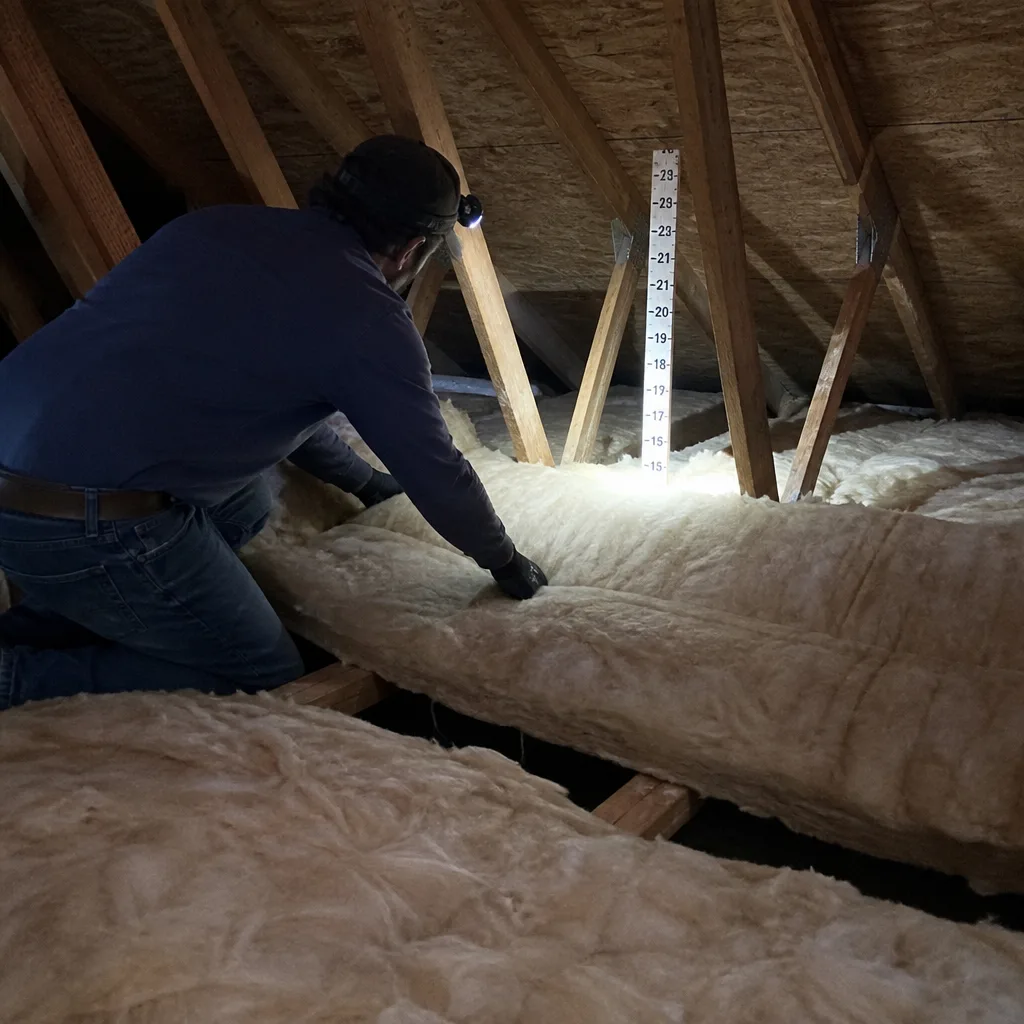
Here’s the exact sequence we follow on every job in Schertz where baffles and ventilation prep are part of the scope. Nothing gets skipped to save time, and every step is photographed under the Documented Photo Record we deliver when the crew leaves.
- Written scope and price before anyone enters the attic. Under Haven Standard Clause 1, you receive a flat written price and a written scope of work before we start. That document names the baffle material, the quantity, the target net free area we’re aiming for, and any penetration sealing included in the job. No surprises when the invoice arrives.
- Full attic inspection and blower-door baseline (where applicable). On jobs that include air sealing alongside ventilation prep, we run a blower-door test – a pressurization measurement that shows, in a single figure, how much conditioned air the home is losing – before any work begins. That number goes into your documentation. On ventilation-only scopes, we measure existing net free area at the soffits and ridge, photograph blocked vents and any collapsed or missing baffles, and note sheathing condition. Wes Okafor or a named lead technician documents the findings in writing.
- Clear the eave bays and verify soffit vent condition. We pull back any existing insulation from the eave bays, remove debris, and inspect each soffit vent for blockage, damage, or inadequate net free area. In some Schertz homes – particularly those built in the late 1990s near FM 1518 – we find soffit vents that are painted over or caulked shut by prior painters. Those get corrected before baffles go in.
- Install baffles from soffit to above the air-sealing plane. We use rigid foam or cardboard rafter baffles, selected for the rafter depth of your specific roof. Each baffle runs from the soffit vent opening up to at least 12 inches above the finished insulation surface, maintaining a minimum 1-inch air channel. Baffles are stapled and, on cathedral ceilings or tight spaces, foam-sealed at the edges so insulation can’t migrate around them. The target net free area – typically a 1:150 or 1:300 ratio depending on your roof configuration and local code – is calculated before installation, not estimated after.
- Air-seal penetrations at the attic floor (always completed before insulation). Top plates, can light housings, plumbing chases, and electrical penetrations are sealed with either two-component spray foam or firestop caulk, depending on the penetration type. This is the step that most contractors either skip or treat as an add-on. We treat it as a prerequisite: we will not blow insulation over an unsealed attic floor. The sealed-first sequence is the reason our before-and-after blower-door numbers show actual performance change rather than just added R-value.
- Final check, photo documentation, and close-out blower-door (where applicable). Every baffle is visually confirmed before insulation is blown. On jobs with air sealing, a close-out blower-door reading is taken and recorded alongside the baseline number, so you have both figures in your documentation. You receive the Documented Photo Record – time-stamped photos of the attic before and after – and your written warranty under the 365-Day Done Right Promise before the crew leaves the property.
Attic Baffles & Ventilation Prep Pricing in Schertz
Baffle and ventilation prep costs in Schertz depend on three things: attic size, rafter bay count, and how much corrective work is needed before baffles can even go in. Here are the honest ranges we see on typical Schertz jobs:
- Baffle installation only (standard 1,500-2,000 sq ft home): $350 – $650. This covers material and labor for rigid rafter baffles in all eave bays, assuming the attic floor is accessible and no major corrective work is needed.
- Ventilation prep plus attic floor air sealing (same size range): $600 – $1,100. When penetration sealing is part of the scope – top plates, can lights, and chases – costs rise because the labor time before insulation roughly doubles. This is the scope that produces measurable blower-door improvement.
- Corrective work (removing blocked insulation from eaves, repairing damaged soffit vents, re-nailing open rafter bays): $150 – $400 added to either range above, depending on severity. On homes in Schertz’s older sections near Schertz Parkway, we regularly find 10-15 eave bays that need this level of corrective prep.
- Full ventilation assessment and blower-door baseline with documentation (standalone, no installation): $175 – $275. Some homeowners want a documented starting point before deciding on scope. That’s a legitimate use of the service.
What moves the number up: two-story homes with longer rafter runs, hip roofs with complex eave geometry, attics that haven’t been touched in 20+ years and need significant cleanup, and cathedral ceiling sections where baffle installation requires foam-sealing rather than stapling alone.
What keeps the number down: single-story slab homes with simple gable roofs, attics with accessible decking, and jobs where the soffit vents are already clear and just need baffles installed on top of clean eave bays.
Every price we give is a written flat price before any work starts – Haven Standard Clause 1. If you have a written estimate from another contractor, bring it to us. We offer a free second opinion on any written estimate and will read it with you line by line.
To get an accurate number for your specific home in Schertz, call (830) 402-5240. The assessment is free, the price is written, and the work doesn’t start until you’ve signed off on both.
FAQs – Attic Baffles & Ventilation Prep
What exactly is an attic baffle and why does it matter in Schertz’s climate?
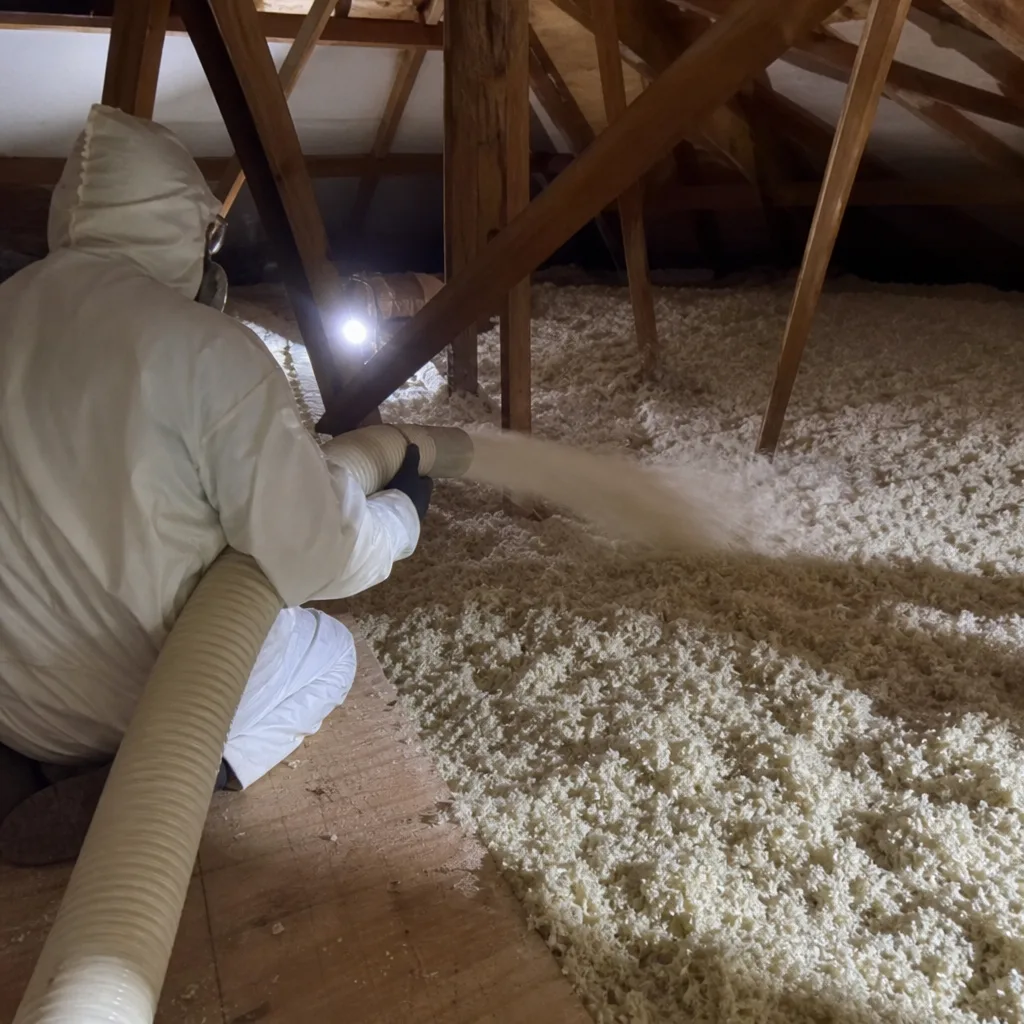
An attic baffle is a rigid channel – typically made from foam or corrugated cardboard – that runs from your soffit vent up past the insulation line to keep a clear air pathway between the outside and your attic space. In Schertz, where attic temperatures can exceed 150°F in July, that airflow channel is what allows hot air to exhaust through the ridge continuously rather than baking against your roof deck and ceiling. Without baffles, blown-in insulation – whether that’s GreenFiber cellulose or Owens Corning fiberglass – slides toward the eaves over time and blocks the soffit vents entirely. Once that happens, you lose the convective loop the ventilation system was designed around, and the attic heats up faster than your AC can compensate for. A baffle is a small thing; the effect of not having one is not.
Can baffles be installed in an attic that already has insulation?
Yes, but it requires pulling the existing insulation back from the eave bays before installation – you can’t slide a baffle in behind insulation that’s already packed against the soffit. On retrofit jobs in Schertz, that clearing step adds labor and sometimes reveals damaged or missing soffit vents underneath that need correction before the baffles go in. We photograph the eave bay condition before and after, so you can see exactly what was found and what was done. If we find problems beyond the original scope – collapsed bays, pest debris, missing vent mesh – we document them and give you a written revised price before touching anything additional.
Do Schertz building codes require attic baffles?
The International Residential Code, which Schertz and the surrounding Guadalupe County jurisdiction follow, requires that ventilation openings be kept clear when insulation is installed to the depth of the rafters. The practical requirement is that soffit ventilation not be obstructed – baffles are the standard method for meeting that requirement when blown-in or Attic Batt Insulation is used. The IRC also sets minimum net free area ratios for attic ventilation: typically 1 square foot of net free vent area per 150 square feet of attic floor, or 1:300 when a vapor barrier is present. We calculate your home’s required net free area as part of the scope, not as an afterthought, so the finished job meets code on paper and in practice.
Why do you seal air leaks before installing baffles instead of after?
Air sealing at the attic floor – top plates, can light penetrations, plumbing chases – has to happen before insulation covers those surfaces. Once you’ve blown 15 inches of cellulose or fiberglass over the attic floor, the penetrations are buried and inaccessible without removing the insulation again. The sequence that produces documented results is: seal the floor first, confirm the seal with a blower-door reading, then install baffles to protect the soffit vent channels, then blow insulation. If we ran it the other way, we’d be adding R-value over an air-leaking floor and calling it a complete job. We don’t do that – and the before-and-after blower-door numbers we publish on every applicable job are what make the difference visible. On a typical Schertz home with moderate leakage, sealing before insulation routinely produces a 30-50% reduction in CFM50 – that’s the pressurization figure that tells you how many cubic feet per minute of conditioned air your home was losing before the work. Call (830) 402-5240 and we’ll walk you through what your home’s baseline might look like based on its age and construction type.
What You Walk Away With
At the end of every baffle and ventilation prep job in Schertz, you have four things in writing: the scope that was agreed to, the price that was quoted, a time-stamped Documented Photo Record showing the attic before and after, and – on jobs that include air sealing – before-and-after blower-door readings that put a number on the performance change. If the job involved air sealing only, you still get the photos. The 365-Day Done Right Promise applies to all completed work: if something isn’t right, Wes Okafor’s team comes back and makes it right. That’s in writing too.
Since 2016, Topside Attic Insulation Near Me in Schertz, TX has completed work on more than 9,000 homes across the region, every one with a written price before work started and a documented record when the crew left. Materials on our jobs come from manufacturers like GreenFiber, Owens Corning, and Demilec – no proprietary product lock-in means we use what performs best for your specific attic configuration.
If you’re ready to get a written price for baffle installation and ventilation prep in Schertz, call (830) 402-5240. The assessment is free, the price is flat and written, and a live person picks up – no voicemail, no callback window measured in business days.
Written by Wes Okafor, Owner at Topside Attic Insulation Schertz, serving Schertz.