
Blown-In Attic Insulation in Schertz, TX
Blown-in attic insulation is one of our Attic Insulation services where loose-fill material – cellulose, fiberglass, or mineral wool – is machine-blown across your attic floor to a specified depth, filling gaps, blocking conductive heat transfer, and building up the R-value your home needs to stay comfortable through a Schertz summer. Most homes in Schertz that are under-insulated can be brought to the current Texas energy code recommendation of R-38 to R-60 in a single half-day visit, with the full work documented in photos before the crew leaves. If you want to talk through your attic before anything is scheduled, call us at (830) 402-5240 – a live person answers, no voicemail loop.
Blown-in insulation is the parent category for a range of attic upgrades we handle under our broader Attic Insulation in Schertz service. What sets this specific application apart is coverage: a blowing machine can fill irregular joist bays, reach corners a batt roll physically cannot, and settle uniformly across an attic floor without the gaps that cut a batt installation’s real-world performance by 20 to 30 percent. In older Schertz neighborhoods like Greenshire and Crossvine, where attics routinely contain tangled wiring runs, recessed lights, and decades of settled or compressed fiberglass, blown-in is almost always the better tool.
Under The Haven Standard – the operating framework Wes Okafor built Envelope Insulation Co. on since 2016 – every blown-in job in Schertz begins with a written price and ends with a documented photo record. The price is flat, the scope is written, and the warranty is in your hands before anyone touches an insulation hose. That’s Haven Standard Clause 1, and it applies without exception.
When You Need Blown-In Attic Insulation
- Your energy bills climb sharply from May through September. Schertz sits in USDA Hardiness Zone 8b and routinely sees three-digit heat indexes through late summer. An attic floor at R-11 or R-19 – common in homes built between 1985 and 2005 in Schertz’s established subdivisions – transfers that radiant load directly into your living space. A blower-door test – a pressurization reading that shows, in one number, how much conditioned air your building envelope is losing – combined with an R-value measurement will show you exactly how much your current insulation is costing you per cooling season.
- Rooms on the top floor are noticeably hotter than rooms below. This is the clearest sign that radiant gain through the attic deck is outpacing your HVAC’s ability to compensate. In two-story homes in the Schertz Farms and Northcliffe areas, we regularly find the upstairs 4 to 7 degrees warmer at peak afternoon hours – a gap that closes measurably after bringing the attic floor to R-49 or higher.
- Your existing insulation is compressed, dirty, or below the joist tops. Fiberglass batts lose R-value as they compress over time. If you can see the tops of your attic floor joists, you are almost certainly under the Texas code minimum. Blown-in cellulose or fiberglass fills over existing material quickly and without removing what is still functional.
- You recently had rodent activity or water intrusion in the attic. Contaminated insulation holds odor, loses performance, and can harbor mold spores. Our process in these cases starts with a removal and cleaning step before any new material goes in – we won’t blow fresh insulation over a compromised attic floor.
- You are preparing for a home sale or energy audit. Schertz buyers in the $350K-$550K range are increasingly requesting energy disclosure documentation. A completed blown-in job with before-and-after blower-door readings and a documented photo record is a concrete asset at closing, not just a talking point.
- Your HVAC system is running longer cycles than it used to. Short cycling and extended run times are both symptoms of thermal load imbalance. Before replacing equipment, it’s worth verifying that your attic floor is doing its job – in a meaningful percentage of calls we receive from Schertz homeowners, a blown-in upgrade resolves the symptom without any HVAC work at all.
Our Blown-In Attic Insulation Process
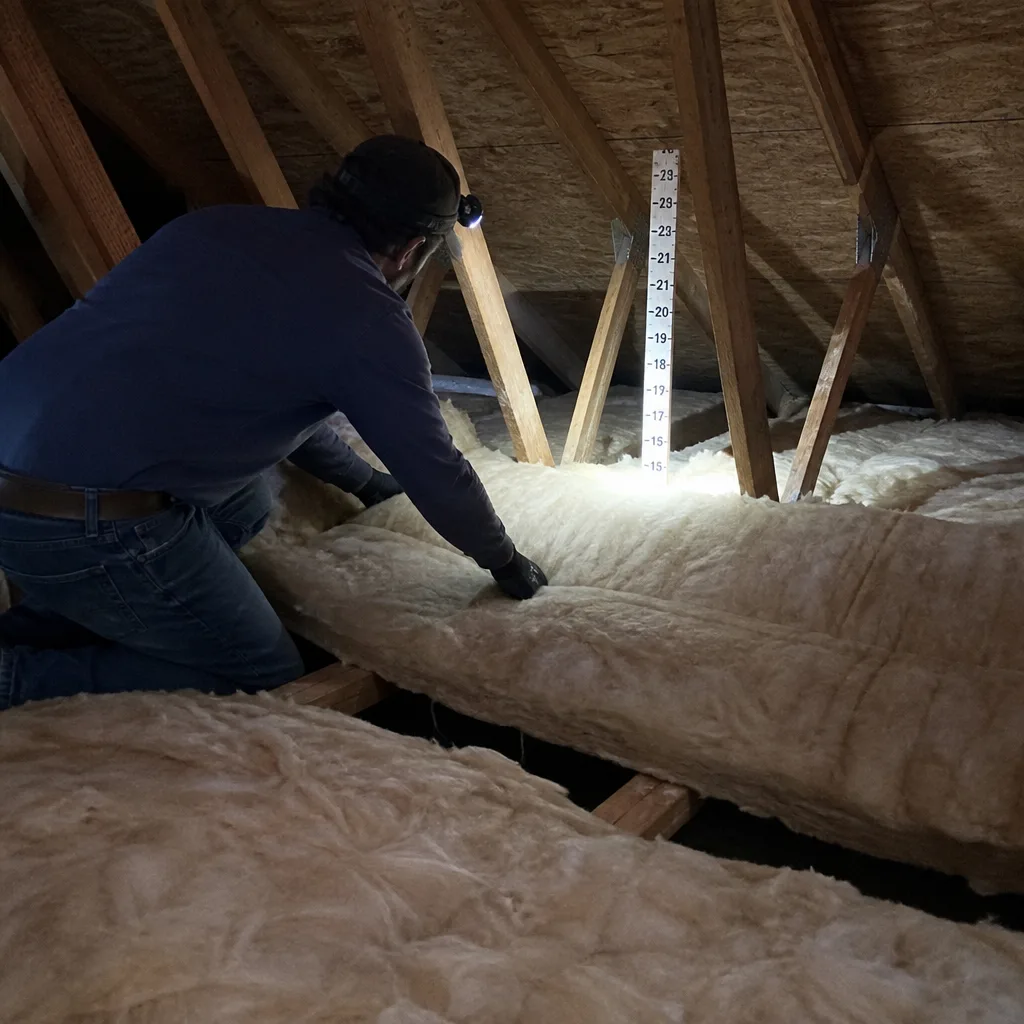
We follow the same sequence on every job because the sequence matters. Blowing insulation before sealing air leaks is the single most common installation error in this trade, and it’s one we don’t make. Here is what the process looks like from your side of it:
- Written scope and flat price before any work begins. Under Haven Standard Clause 1, you receive a written price – not an estimate range, a flat number – along with a written scope of work and warranty before we schedule the install date. We measure your attic’s square footage, assess existing R-value with a calibrated depth gauge, and calculate the target depth for the material we’re recommending. The math is shown to you explicitly.
- Air sealing of the attic floor. This step is not optional and not an upsell. We seal top plates – the framing members where interior walls meet the attic floor – recessed can lights, plumbing and electrical penetrations, and any other bypass with fire-rated foam or caulk rated for the application. In Schertz homes built before 2000, we typically find 15 to 30 separate air bypass points before the blowing machine ever comes out. Skipping this step means blowing insulation over an open air channel – the insulation slows conduction but does nothing to stop convective air movement through those gaps. We seal first. Then we insulate.
- Depth marker installation. Before blowing starts, we place calibrated depth rulers across the attic floor at regular intervals. These markers confirm the crew is reaching target depth uniformly – not just in the center of the attic where access is easiest, but at the eaves and corners where heat transfer is highest. In Schertz’s ranch-style homes, eave access can be tight; depth markers keep the crew honest in those areas.
- Material selection and machine setup. For most Schertz attics, we use blown-in fiberglass or cellulose depending on the job’s specific conditions – cellulose from GreenFiber where fire-rating and density are priorities, Owens Corning blown-in fiberglass where moisture resilience matters more. Both materials are certified for the application. We do not push a proprietary product because we are not locked into one supplier.
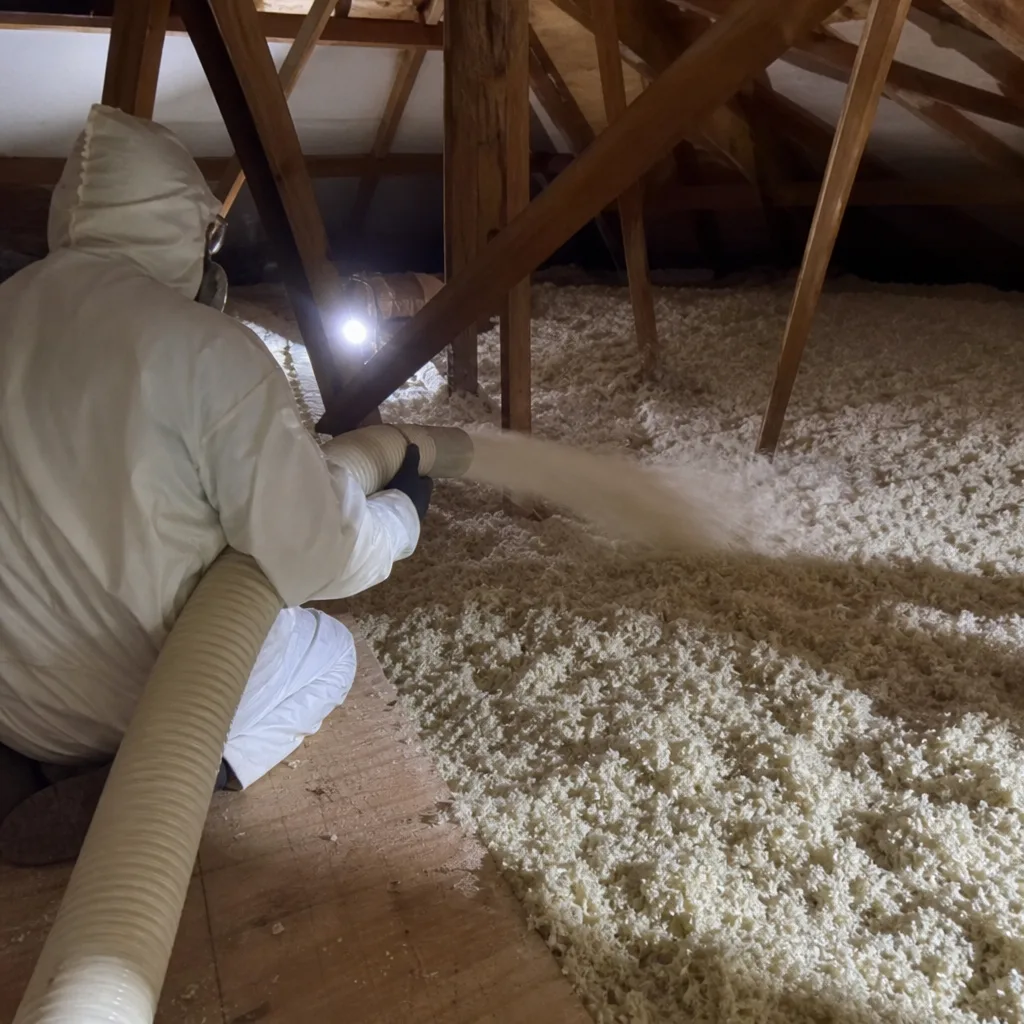
- Blowing to target depth and R-value. The hose runs from the truck into the attic. Material is distributed from the far end of the attic toward the hatch, working in passes to build uniform depth. A typical 1,500-square-foot attic floor takes two to four hours to bring from R-11 to R-49. When blowing is complete, depth is re-checked against every marker before the hatch closes.
- Blower-door test and documented photo record. On applicable jobs – which includes virtually every Schertz blown-in project where air sealing was performed – we run a blower-door test before and after, and both numbers go into your job record. We also photograph the completed attic floor, the depth markers, the sealed penetrations, and the hatch framing. You receive this documentation the day of the job. Under the 365-Day Done Right Promise, if any part of the work doesn’t hold up, we come back and fix it – in writing, no exceptions.
Blown-In Attic Insulation Pricing in Schertz
If you’re wondering How Much Does Attic Insulation Cost? (2026 Price Guide) - Schertz, TX, blown-in attic insulation typically runs between $1.20 and $2.10 per square foot for the insulation installation itself, not counting air sealing or any removal work. For context, that means a 1,200-square-foot attic floor comes to roughly $1,440 to $2,520 depending on material choice, current R-value, and target depth. Air sealing – which we require as a prerequisite – generally adds $300 to $700 to the job, depending on how many bypass points we find and how accessible they are.
The table below reflects what we see in Schertz homes in our service area. These are real job-type ranges, not minimum-installation teaser prices:
| Job Type | Typical Schertz Price Range |
|---|---|
| Air sealing only (attic floor, no insulation added) | $350 – $700 |
| Blown-in insulation, 1,000-1,500 sq ft attic, R-11 to R-38 | $1,400 – $2,200 |
| Blown-in insulation, 1,500-2,500 sq ft attic, R-11 to R-49 | $2,100 – $3,800 |
| Blown-in with air sealing, full package, 1,500 sq ft attic | $2,200 – $3,200 |
| Blown-in over existing material, top-off to code depth | $800 – $1,600 |
| Old insulation removal + blown-in replacement | $2,800 – $5,000+ |
What moves the price up or down: attic access difficulty (a scuttle hatch in a closet versus a full pull-down stair), the number of HVAC ducts and fixtures in the attic floor plane, the depth of existing insulation, and whether we find moisture damage or contamination that needs to be addressed first. Homes in Schertz’s older sections – particularly around Live Oak Hills and the streets feeding into Schertz Parkway – often have the deepest access complications because of how those attics were framed.
You will receive a flat written price before any work begins. If you have a written estimate from another contractor, bring it to us – we offer a Free Second Opinion on any written estimate and will read it with you line by line.
FAQs – Blown-In Attic Insulation
How much does blown-in attic insulation cost in Schertz?
Most blown-in attic insulation projects in Schertz fall between $1,400 and $3,800 for the insulation itself, depending on attic size and target R-value. Adding air sealing – which we treat as a prerequisite, not an optional add-on – typically brings the full project to $2,200-$4,500 for a standard single-story home. The number that matters for your specific attic is the one written on your flat-price proposal. Call us at (830) 402-5240 and we will measure your attic, assess your current R-value, and give you a flat written price – no work starts without it.
What R-value does my Schertz attic need?
The current DOE recommendation for Climate Zone 2 – which covers Schertz and most of south-central Texas – is R-38 to R-60 for attic floors, with R-49 being the practical target for most existing homes. Texas energy code for new construction sets R-38 as the floor. Many homes in Schertz built before 2005 are sitting at R-11 to R-22, which means they are losing a significant portion of their cooling load through the attic every summer. We measure your existing R-value on-site with a depth gauge before quoting any work, so you know exactly where you are starting from.
Is blown-in insulation better than batts for Schertz attics?
For most Schertz attics, yes – blown-in material outperforms batts in real-world conditions because it fills irregular joist bays completely and doesn’t leave the edge gaps and compression points that reduce a batt installation’s effective R-value by 20 to 30 percent. Attic Batt Insulation makes sense in a clean, wide-open attic with standard joist spacing and no existing insulation to work around. In the attics we see most often in Schertz – older framing, mixed penetrations, settled or compressed existing material – blown-in is the more reliable tool. That said, the right answer depends on what we find in your specific attic, and we will tell you which approach makes sense after we look.
How long does blown-in attic insulation last in Schertz’s climate?
Blown-in cellulose and fiberglass both maintain their rated R-value for 20 to 30 years under normal attic conditions, provided there is no moisture intrusion, pest activity, or physical disturbance. Schertz’s heat and humidity accelerate the degradation of older fiberglass batts but do not meaningfully shorten the lifespan of properly installed blown-in material. The documentation you receive after every Topside Attic Insulation Schertz job – the photo record, the blower-door readings, the written warranty – gives you a baseline you can refer back to if you ever question whether the insulation is still performing. Under the 365-Day Done Right Promise, any performance issue we can trace to the installation is corrected at no cost.
Why Schertz Homeowners Choose Topside Attic Insulation Schertz
Since 2016, the crews working under Wes Okafor have completed blown-in and air sealing work in more than 9,000 homes, every one with a written price before work started and a documented record when the crew left. That’s not a marketing position – it’s the structure The Haven Standard was built on, and it applies to every Schertz job the same way it applies to every other market we work in.
The specific thing that separates our process from most competitors in the Schertz area is Attic Baffles & Ventilation Prep and the sequencing rule: we seal the attic floor before we insulate it. This sounds obvious but it isn’t standard practice. A significant percentage of blown-in jobs performed in this market are installed over an unsealed attic floor, which means the insulation slows conduction but does nothing to stop conditioned air from moving freely through open top plates and penetrations. A blower-door reading taken after that kind of job looks nearly identical to the reading taken before it. We publish both numbers so you can see the difference yourself.
Materials we use on Schertz blown-in jobs include GreenFiber cellulose and Owens Corning blown-in fiberglass, selected based on the job’s specific moisture and fire-rating conditions. We are not locked into a single supplier, which means we choose the right material for your attic rather than the one that generates the best margin for us.
If you want to compare our scope and price against another written estimate, bring it. We offer a Free Second Opinion on any written estimate – we read it with you, line by line, and tell you what the numbers actually mean. No pressure, no theatre.
For more on our full attic service line in this market, including radiant barrier installation, insulation removal, and attic cleaning, visit our home page to see everything Topside Attic Insulation Schertz handles.
Schedule Your Blown-In Attic Insulation Estimate in Schertz
If your Schertz home is running hot upstairs, carrying high summer energy bills, or simply hasn’t had its attic assessed since you moved in, the starting point is a measurement – not a guess. We will measure your attic’s square footage, check your existing R-value with a depth gauge, identify air bypass points that need sealing, and give you a flat written price before anyone schedules a crew. That price covers labor, material, depth markers, air sealing of identified penetrations, and the blower-door test. No hidden line items added at the truck.
Call (830) 402-5240 to schedule your free estimate. A live person answers – no voicemail, no callback window. If you prefer to start in writing, we are set up for that too. Either way, you will have a flat written price in hand before any work is scheduled, because that’s how every Topside Attic Insulation Schertz job begins.
Written by Wes Okafor, Owner at Topside Attic Insulation Schertz, serving Schertz since 2016.