
Demilec Crawl Space Encapsulation: The Schertz Owner’s Guide
We stock and install Demilec-compatible crawl space encapsulation systems in Schertz, with most full encapsulations running between $3,800 and $7,200 depending on crawl footprint and whether the foundation needs active dehumidification tied in. Same-day assessments are available, and we carry Demilec vapor barrier materials and seam tape on our trucks. Most Schertz homeowners discover their encapsulation has failed when they notice musty odors returning in spring after heavy rains, or when their dehumidifier runs continuously without dropping relative humidity below 65%.
Which Demilec Models This Applies To
Demilec’s crawl space line breaks down into three product families you’re likely to encounter in Schertz homes built between 2005 and 2020: the Heatlok HFO Pro series (closed-cell spray foam used for rim joist sealing), the Demilec vapor barrier films in 10-mil and 16-mil thicknesses, and the Demilec seam tape and mastic systems used to join barrier sections. The critical identification point is the mil rating stamped on the barrier edge, usually found in the corner folds where the material meets the foundation wall. HFO Pro is labeled with a batch code starting with “HLK,” while the vapor barriers carry a “DVB” prefix.
We are an independent service provider, not affiliated with Demilec. For barrier replacement, we typically source OEM-equivalent 16-mil reinforced polyethylene from our supply chain rather than Demilec-branded film, because the spec matches and the seam tape adhesion is identical. The one compatibility gotcha in Schertz: Demilec’s original 10-mil barrier used through 2012 had a narrower 6-inch overlap standard, while post-2012 installs moved to 12-inch overlaps. If your existing barrier shows 6-inch seams, we need to extend the new barrier further up the wall to maintain the seal, which adds roughly 15% to material cost.
Signs Your Demilec Crawl Space Encapsulation Is Failing
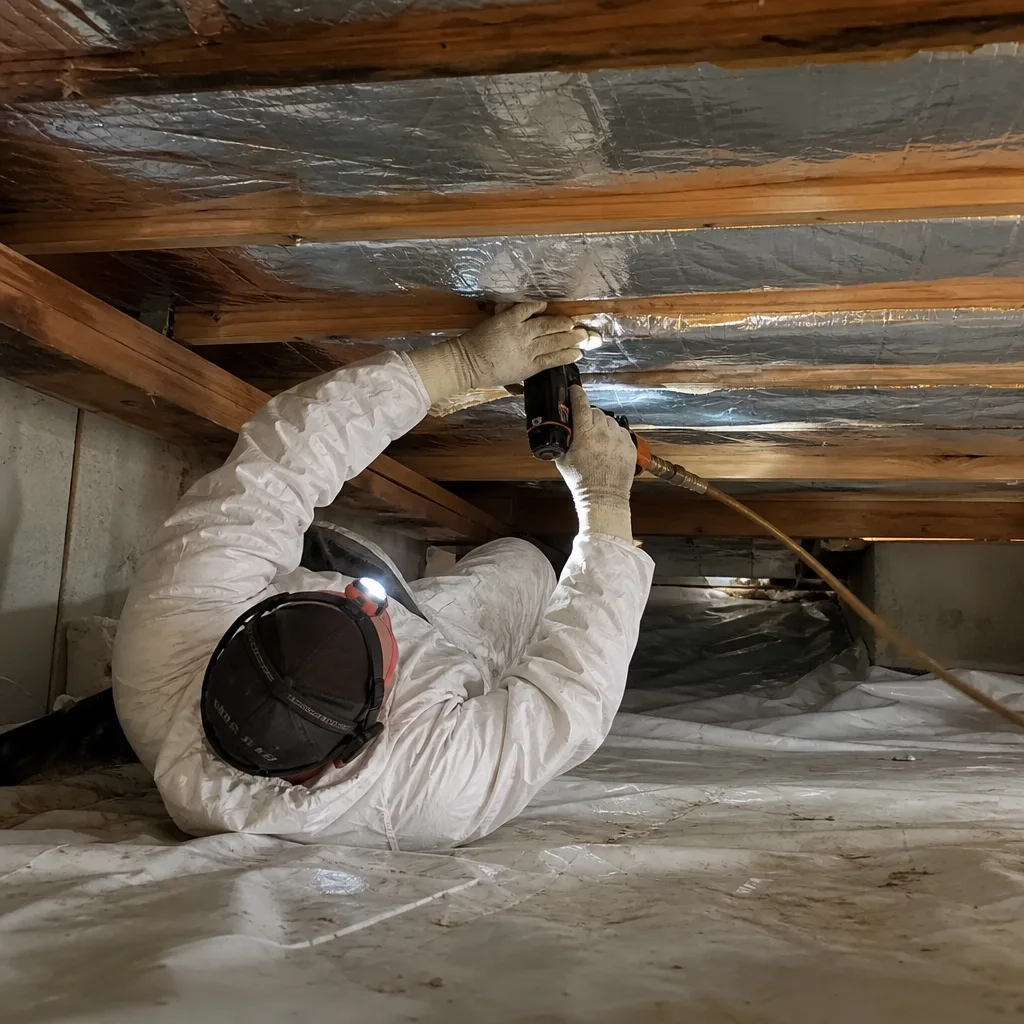
- Condensation on HVAC ducts in July and August. When the vapor barrier separates at wall seams or the rim joist foam cracks, humid Gulf air enters the crawl and condenses on cold ductwork. In Schertz, we see this most in homes east of I-35 where the water table sits higher and summer dew points stay above 70°F for weeks.
- Soft or bouncy flooring above the crawl, especially near exterior walls. This means moisture is reaching the subfloor and beginning to degrade the OSB or plywood. The Demilec barrier failed at the perimeter, or the rim joist foam has pulled away and is no longer blocking air infiltration.
- Your dehumidifier runs 18+ hours daily and the bucket never fills. A properly sealed crawl with a correctly sized dehumidifier should cycle, not run continuously. If the unit never reaches setpoint, the envelope is leaking faster than the dehumidifier can extract.
- White, chalky residue on the barrier surface. This is efflorescence from vapor drive pushing mineral salts through concrete walls, and it signals that the barrier is no longer blocking soil moisture migration. The 16-mil barrier should prevent this entirely if intact.
- Insect activity increasing in spring. Termites and carpenter ants exploit gaps in barrier seams to access the subfloor structure. A continuous Demilec barrier is part of the pest management strategy, not just moisture control.
Replacement Cost & What’s Included
In Schertz, a full Demilec-compatible crawl space encapsulation typically runs $3,800 to $5,400 for a 1,200 to 1,800 square foot crawl with standard wall height, and $5,800 to $7,200 if we need to add a dedicated dehumidifier with condensate pump and discharge line. The lower end assumes barrier replacement with existing rim joist foam intact; the upper end includes removing failed foam, re-sealing rim joists with closed-cell spray foam, and installing a Santa Fe or AprilAire dehumidifier sized to the space.
Every quote breaks out parts and labor separately under Haven Standard Clause 1. You get the written scope, the written warranty, and the flat price before anyone enters the crawl. The 365-Day Done Right Promise covers both materials and installation. On completion, we deliver a Documented Photo Record showing seam overlaps, wall terminations, and dehumidifier placement, plus blower-door readings if the crawl connects to conditioned space through floor penetrations.
DIY or Call Us?
There’s one thing a Schertz homeowner can safely check: the dehumidifier. Verify it’s set to 55% relative humidity, the filter is clean, and the condensate line isn’t clogged. If the unit runs properly and humidity still climbs, the problem is in the envelope, not the machine.
Everything else belongs to a crew. Crawl spaces in Schertz are confined spaces with limited ventilation, and disturbed fiberglass or rodent droppings create respiratory hazards. More critically, proper encapsulation sequencing matters: we inspect the sill plate and band joist for rot before sealing anything, because trapping moisture against damaged wood accelerates decay. The barrier must lap correctly at seams, terminate at walls with mechanical fastening, and integrate with any existing drainage or sump systems. A wrinkle or gap at the wall base becomes a condensation channel within one humid season.
Call (830) 402-5240 and we’ll walk through what you’re seeing. Estimates are free, and we carry a Free Second Opinion on any written estimate you’ve already received.
FAQs
A properly installed 16-mil reinforced barrier with correct seam overlaps typically lasts 15 to 20 years in Schertz’s climate, though the rim joist spray foam may need inspection at year 10 due to thermal cycling. The limiting factor is usually mechanical damage during plumbing or HVAC service work, not material degradation. Call (830) 402-5240 for an assessment if your install is approaching 15 years.
Localized repairs work if the failure is limited to one or two seam separations or a single wall section, but we don’t patch over widespread barrier embrittlement or multiple adhesive failures. In Schertz, we find that partial repairs often leave adjacent weak points that fail within 18 months. We quote both options when we inspect. Call (830) 402-5240 for a written scope on either approach.
Most residential crawls in Schertz take one to two days: day one for removal, sill inspection, and any rim joist foam work; day two for barrier installation, dehumidifier setup, and final documentation. Larger crawls or those requiring drainage correction may extend to three days. We schedule consecutive days and stay until the Documented Photo Record is complete.
We carry 16-mil reinforced vapor barrier, seam tape, mastic, and closed-cell spray foam compatible with Demilec specifications on every Schertz truck. For model-specific components like proprietary fastening systems, we source overnight from our supplier. In most cases, we can assess and begin work same-day or next-day. Call (830) 402-5240 to confirm availability for your specific setup.
Written by Wes Okafor, Owner, Topside Attic Insulation Schertz at Topside Attic Insulation Schertz, serving Schertz and nearby areas.