
Demilec Radiant Barrier Installation: The Schertz Owner’s Guide
We stock and install Demilec-compatible radiant barrier systems in Schertz, with most residential retrofits running between $1,800 and $3,400 installed, depending on attic square footage and whether the existing insulation needs to be cleared first. Same-day installation is available when we have your attic dimensions and a few photos ahead of the call. Homeowners usually figure out something’s wrong when their summer electric bills spike $80-$150 over the previous year, or when they climb up and find the reflective surface has gone matte, torn along the rafters, or peeled away from the ridge line entirely.
Which Demilec Models This Applies To
Demilec doesn’t sell radiant barrier as a standalone branded kit. Their systems are typically specified as part of a hybrid attic assembly: Demilec spray foam on the roof deck paired with a radiant barrier substrate, or Demilec Heatlok HFO foam applied over a radiant foil layer on the gable ends. If your home was built between 2015 and 2022 in Schertz, particularly in the Sedona subdivision off FM 1518 or the newer builds near Passerine Parkway, there’s a good chance your builder used this exact stack.
To identify what you’re working with, look for the Demilec batch label on the foam itself, usually stamped on the roof deck near the access hatch. The radiant barrier component will either be a perforated foil stapled to the rafters or a foil-faced OSB used as roof sheathing. We carry both: the 48-inch perforated aluminum for rafter retrofit and the 4×8 foil-faced structural panels when the sheathing itself has delaminated. Aftermarket equivalents from Reflectix match Demilec’s emissivity spec of 0.03 or lower, but the perforated versions must be matched carefully. Unperforated foil in a mixed attic traps moisture and voids most manufacturer warranties in Texas humidity. Topside Attic Insulation Schertz is an independent service provider, not affiliated with Demilec.
Signs Your Demilec Radiant Barrier Installation Is Failing
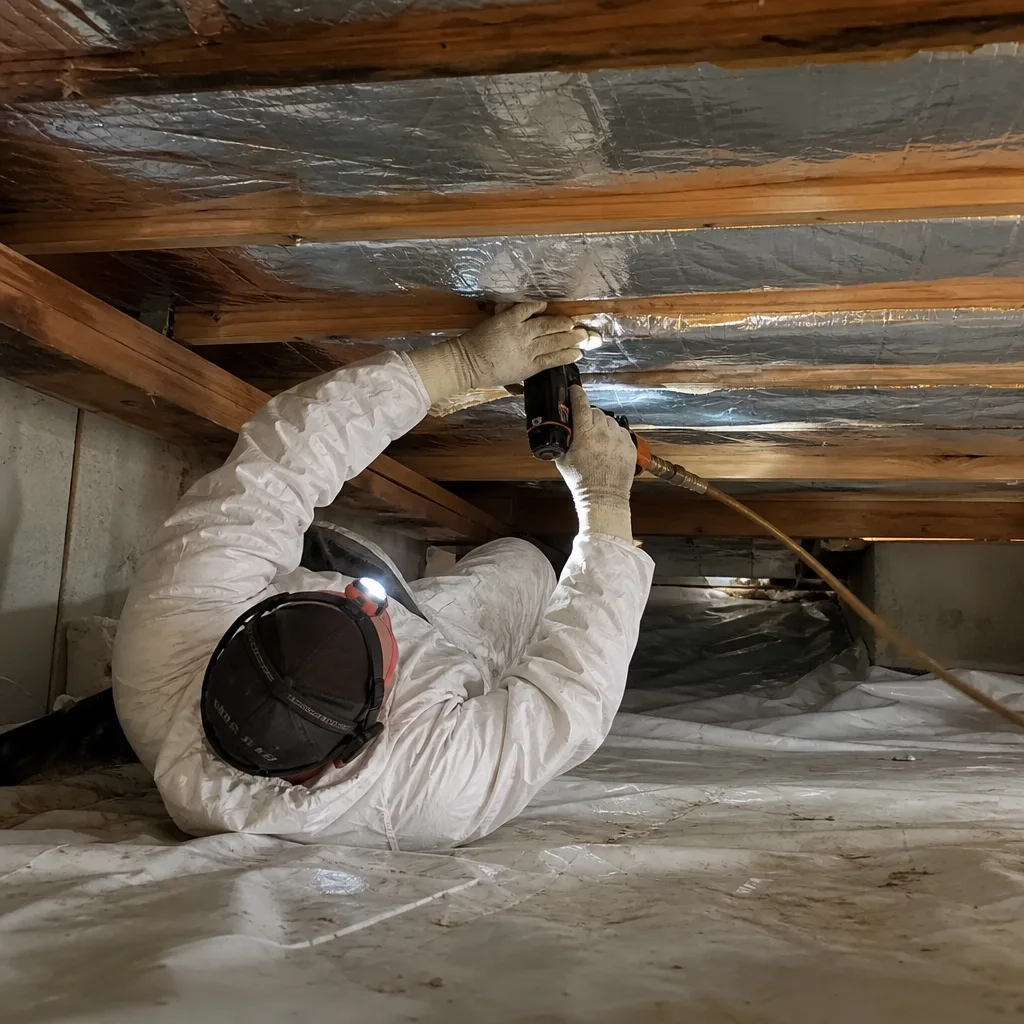
- Surface oxidation or chalking. The reflective coating degrades to a dull gray or white film, usually starting at the ridge where attic heat concentrates. Once emissivity climbs above 0.10, the barrier is reflecting less than half the radiant heat it was designed to block.
- Staple tear-out along rafters. Schertz’s 140°F peak attic temperatures soften the adhesive on cheap staples, and the foil pulls away in strips. You’ll see it hanging like loose wallpaper, or bunched against the ridge vent where air movement pushed it.
- Condensation staining on the foil face. This means your attic ventilation is out of balance with the barrier. In Schertz’s spring and fall, when outside dew points swing hard, unperforated foil can act as a vapor barrier and trap moisture against the roof deck.
- Insulation compression directly below the barrier. When radiant barrier fails, the heat load shifts downward and cooks the top layer of your blown-in insulation. We see this in Schertz homes with original builder-grade fiberglass that’s flattened to half its labeled depth.
- Temperature stratification in living spaces. Rooms under the attic run 6-10°F warmer than the thermostat setting by mid-afternoon. The barrier isn’t rejecting solar gain, and your HVAC is fighting a roof that’s essentially a radiant heater.
Replacement Cost & What’s Included
For a typical 1,800-2,400 square foot Schertz home, Demilec-compatible radiant barrier retrofit runs $1,800-$2,800 if we’re working over existing insulation that tests dry and intact. If the attic needs clearing, rodent debris removal, or the existing insulation is compressed below R-19, the range shifts to $2,600-$3,400. That includes the perforated foil or foil-faced sheathing, all fasteners rated for 200°F continuous exposure, sealing of the access hatch, and a post-install blower-door test to confirm we didn’t open new leaks.
What drives the spread: attic pitch (steeper = more square footage of barrier), whether we need to build catwalks to protect existing insulation during work, and how many penetrations (duct chases, flues, wiring runs) need custom cutting and sealing. Every job gets a Written Price Before Any Work Starts under Haven Standard Clause 1. The 365-Day Done Right Promise covers the installation, and the materials carry their own manufacturer warranty against delamination or emissivity degradation.
DIY or Call Us?
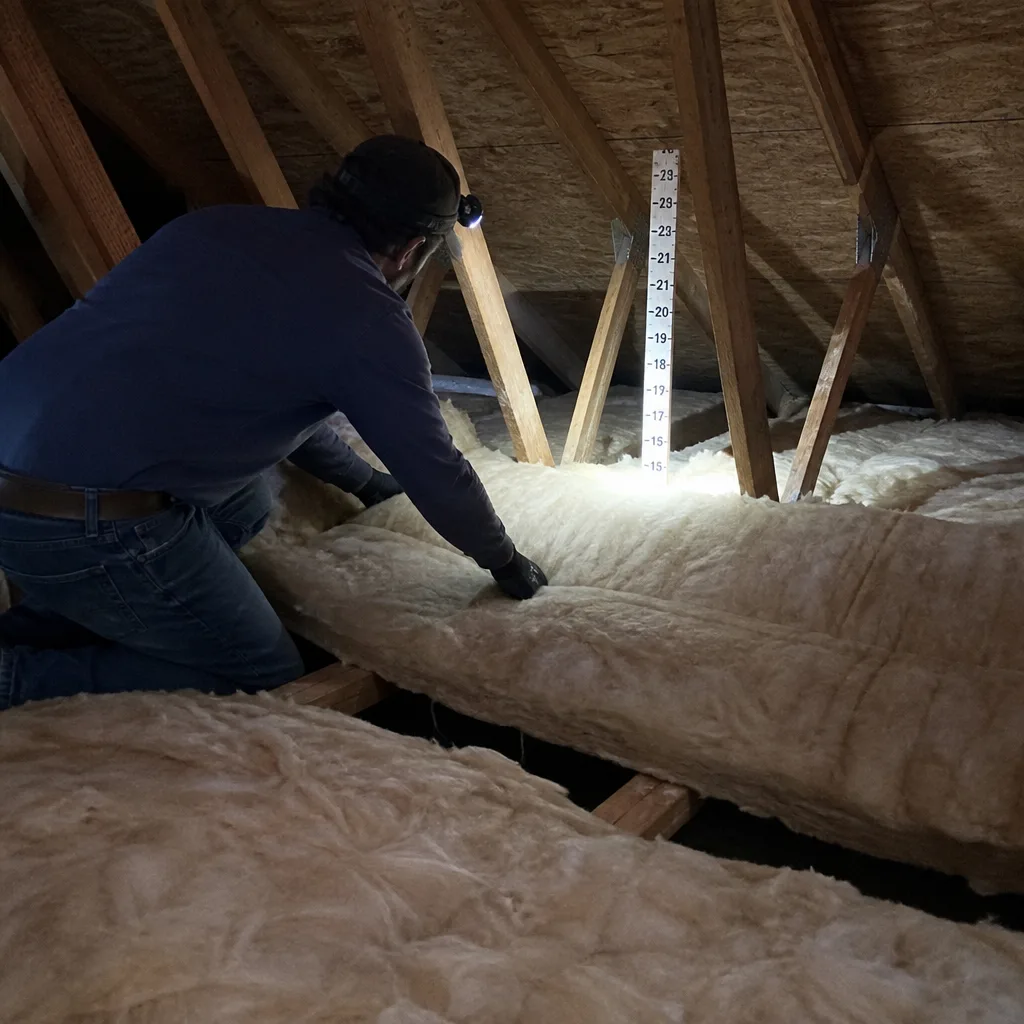
There’s nothing inherently dangerous about radiant barrier material itself. It’s lightweight foil, not high-tension cable or live voltage. Where DIY goes wrong in Schertz is the sequencing and the conditions you’re working in. Attic air temperatures in July and August regularly hit 140°F, and heat exhaustion arrives faster than most homeowners expect. Beyond that, walking through blown-in insulation compresses it and destroys R-value. Kneeling on a rafter bay to staple foil risks putting your foot through a drywall ceiling.
What you can safely check: confirm whether your foil is perforated (hold it to light; tiny holes should be visible), look for batch labels on any spray foam, and photograph the access hatch and a few rafter bays for us to review. What we handle: the blower-door test to establish your baseline air leakage, the air sealing of top plates and penetrations before any barrier goes up, and the installation itself with proper catwalks and thermal protection. Call (830) 402-5240 and we’ll walk through what your photos tell us. Estimates are free, and we deliver a written price before anyone schedules work.
FAQs
In the Schertz climate, a properly installed perforated aluminum radiant barrier maintains its rated emissivity for 15-25 years. The killer is usually not the foil itself but the installation: staples that corrode, tear-out from thermal cycling, or unperforated products that trap moisture and accelerate roof deck decay. We see premature failure most often in homes where the barrier was installed before the attic was properly air-sealed. Call (830) 402-5240 and we’ll assess whether yours is aging normally or failing early.
Localized tear-out can sometimes be patched with matching foil and proper overlap sealing, but oxidation or widespread staple failure means replacement. Patched barriers create seams that become new failure points, and mismatched emissivity between old and new material creates hot spots. We don’t recommend partial replacement unless the damage is limited to a single bay from a known impact. For a free second opinion on whether repair or replacement makes sense, call (830) 402-5240.
Most residential retrofits in Schertz are completed in one day, typically 4-6 hours for a crew of two. That includes setup, the pre-install blower-door test, air sealing of accessible penetrations, barrier installation, and cleanup. Second-story homes or complex rooflines with multiple dormers add time. We text you a 30-minute arrival window the morning of, and you’ll receive the Documented Photo Record and blower-door results before we leave.
We carry perforated 48-inch aluminum radiant barrier and foil-faced structural sheathing on every Schertz truck, along with high-temperature fasteners and the sealants needed for penetration detailing. For Demilec-specific hybrid assemblies, we verify the foam batch and substrate type from your photos before dispatch so there’s no mismatch. Same-day installation is available when we confirm stock compatibility by mid-morning. Call (830) 402-5240 to check today’s availability.
Written by Wes Okafor, Owner, Topside Attic Insulation Schertz at Topside Attic Insulation Schertz, serving Schertz and nearby areas.