
Rockwool Crawl Space Encapsulation: The Schertz Owner’s Guide
Rockwool crawl space encapsulation systems in Schertz typically run $2,800-$4,600 installed for a standard 1,200-1,800 square foot crawl space, and we stock the full Rockwool-compatible vapor barrier, drainage matting, and seam-tape inventory on our trucks for same-day starts. Most Schertz homeowners discover their encapsulation is failing when musty odors return to the first floor after a rain, or when they notice the fiberglass batt insulation overhead has begun to droop and darken at the edges. The Texas Hill Country clay soils around Schertz shift seasonally, and that movement stress-cracks polyethylene seams that weren’t heat-welded or properly taped at the perimeter walls.
Which Rockwool Models This Applies To
Rockwool doesn’t manufacture a standalone “encapsulation system” under its own brand; rather, we pair Rockwool Comfortboard 80 or Comfortboard 110 rigid mineral wool boards with independent vapor-barrier and drainage-mat assemblies for the complete encapsulation. The critical match is board thickness to your crawl space’s framed height: 1.5-inch boards need a minimum 2-inch clearance to grade, while 2-inch boards require 2.5 inches. We’ve seen Schertz homes in the Old Town district with 1920s pier-and-beam foundations that only clear 14 inches, forcing us to spec 1-inch Comfortboard 80 and supplement with closed-cell spray foam at the rim joist.
Identification is straightforward: Rockwool boards carry a stamped density rating (8.0 pcf for Comfortboard 80, 11.0 pcf for 110) and a lot number on the foil-facing edge. For the vapor barrier, we source 12-mil reinforced polyethylene from independent suppliers, not Rockwool OEM, because Rockwool’s distribution chain doesn’t stock crawl-specific barrier material in the San Antonio metro. The aftermarket barrier we use exceeds ASTM E1745 Class A standards, same as any OEM would claim. If your existing encapsulation was installed by a previous contractor, check whether they used true Rockwool board or substituted a lower-density mineral wool; the wrong density crushes under foot traffic during maintenance access and loses its R-value within three years.
Signs Your Rockwool Crawl Space Encapsulation Is Failing
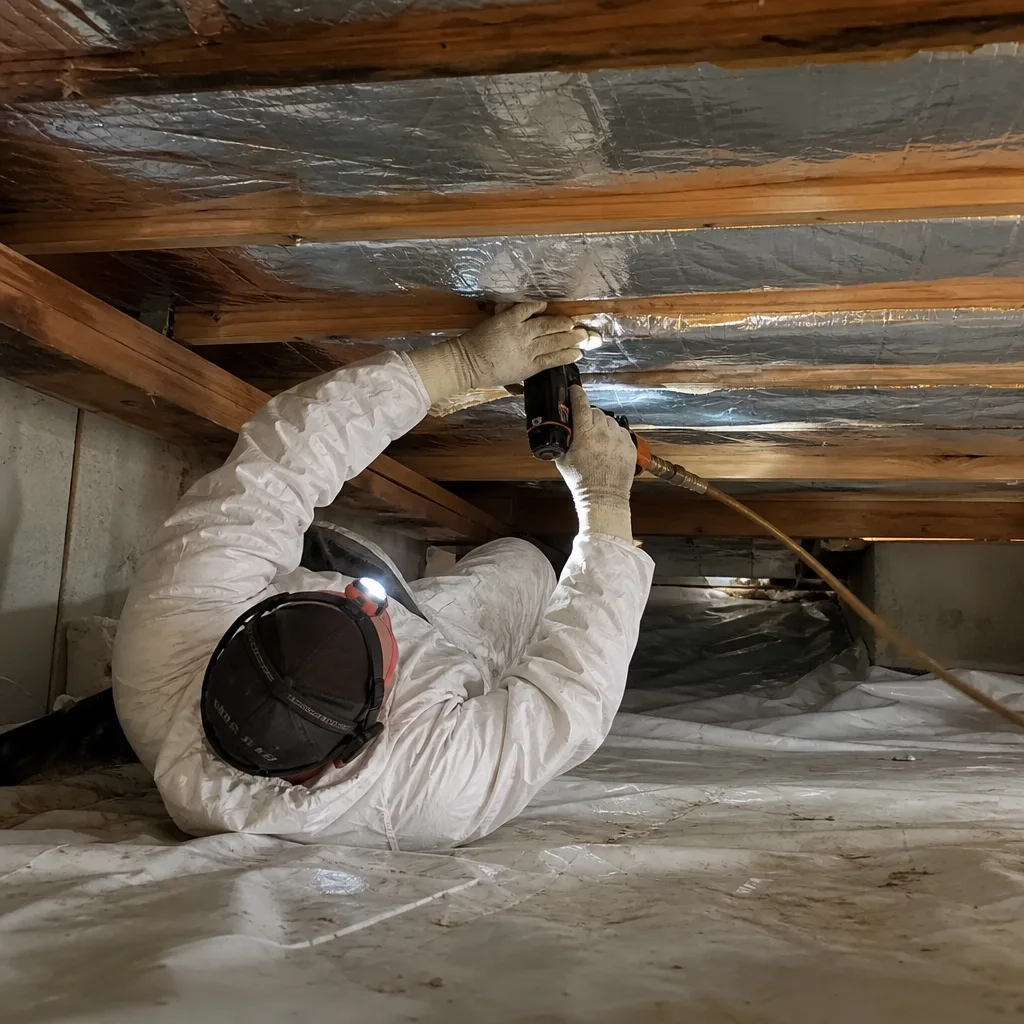
- Musty odors returning to living spaces. This means your vapor barrier has separated at a seam or the perimeter wall, letting soil moisture and radon-laden air bypass the seal. In Schertz’s gumbo clay soils, hydrostatic pressure after heavy rain pushes water vapor through gaps as small as a pencil line.
- Fiberglass insulation overhead sagging or darkening. When the encapsulation fails, relative humidity in the crawl space climbs above 70%, and that moisture condenses on the cooler subfloor. The fiberglass batts act like wicks, pulling water until they deform and compress.
- Increased energy bills with no HVAC changes. Failed encapsulation means your crawl space is essentially outside air temperature, forcing your ductwork to condition 85°F humid air in summer instead of sealed, tempered space. We’ve measured 18% cooling-load increases in Schertz homes with compromised barriers.
- Pest activity or rodent trails on the barrier surface. Torn polyethylene creates harborage; raccoons and opossums in the Schertz greenbelt corridors will exploit any gap. The damage is usually at access doors or where the barrier meets the foundation wall.
- Visible pooling or efflorescence on the crawl floor. This indicates your drainage matting is clogged or was never installed beneath the vapor barrier. The white mineral deposits are salts left behind as groundwater evaporates through the failed seal.
Replacement Cost & What’s Included
Most full Rockwool crawl space encapsulation replacements in Schertz fall between $2,800 and $4,600 for the complete assembly: removal of failed barrier and drainage mat, installation of new 12-mil reinforced polyethylene with heat-welded seams, new dimpled drainage matting, Rockwool Comfortboard at rim joists where specified, and mechanical dehumidifier tie-in if the existing unit is undersized. The range driver is access: homes with exterior crawl doors and 3-foot clearance run toward the lower end; interior hatches through closets, or foundations requiring temporary vent enlargement, push toward the higher end.
Every replacement includes our Documented Photo Record, before-and-after humidity readings with a calibrated thermo-hygrometer, and the 365-Day Done Right Promise backed by written scope and warranty delivered before crew arrival. We don’t start until you have the flat price in hand. Haven Standard Clause 1: written price, written scope, written warranty. No exceptions.
DIY or Call Us?
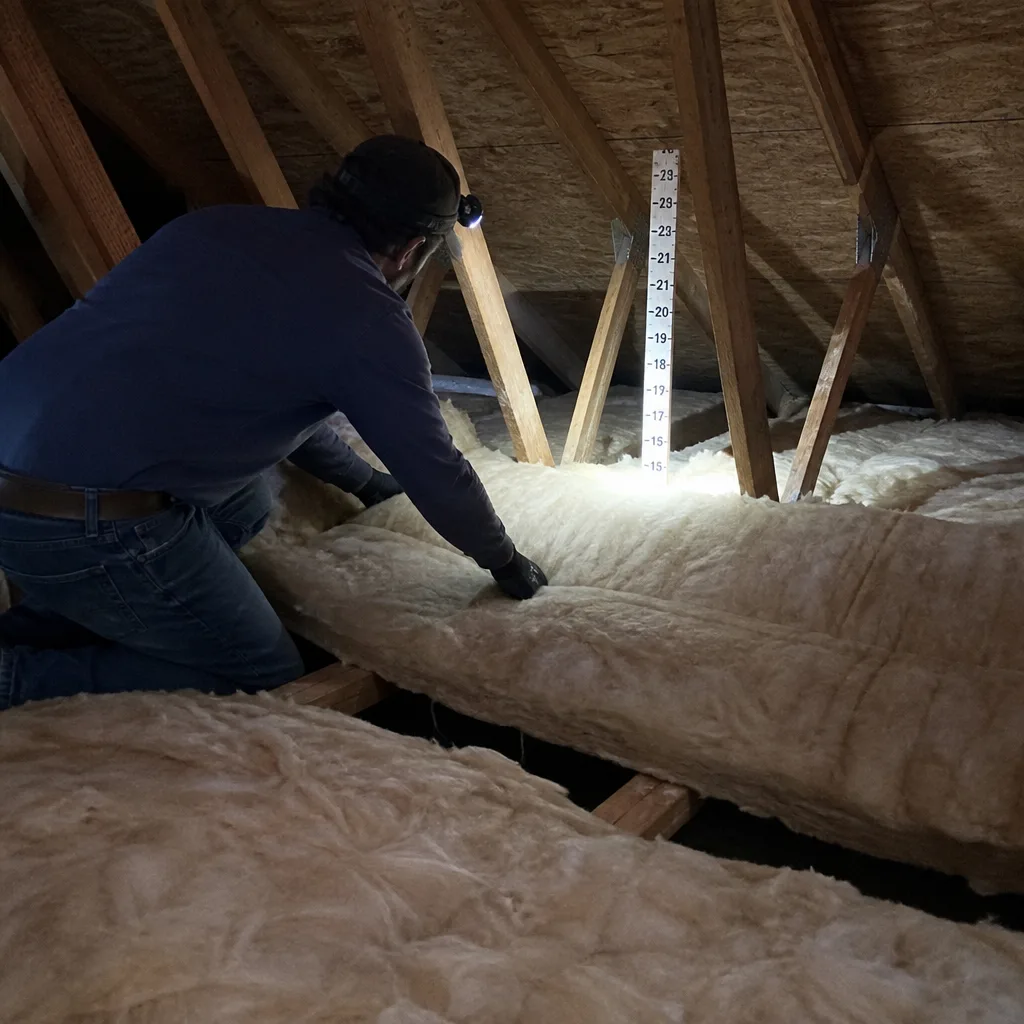
There’s no high-tension danger in crawl space encapsulation like you’d find with garage door springs, but there’s a sequencing trap that wastes money. A homeowner can safely inspect: check the perimeter tape adhesion with a fingernail, look for standing water, and photograph any barrier damage for reference. Where DIY fails is the prep work. Sealing the rim joist and sill plate with proper air barriers before laying the new vapor barrier is what actually stops the moisture drive. We’ve been called to Schertz homes where a homeowner laid $800 in new polyethylene over an unsealed sill, and the failure recurred in eleven months.
We carry Rockwool-compatible board, barrier, and seam tape on every truck. If you’re unsure whether your existing board is salvageable, call (830) 402-5240. We’ll read your situation with you, and our Second Opinion on any written estimate is free.
FAQs
A properly installed system with heat-welded seams and sealed perimeter walls lasts 15-20 years in Schertz’s climate. The Hill Country’s freeze-thaw cycles and clay soil movement are the main wear factors; we’ve seen DIY tape-only installations fail in 3-4 years. Call (830) 402-5240 for an assessment of your current system’s remaining life.
Patching works for isolated punctures smaller than a quarter, using 12-mil polyethylene tape on clean, dry surfaces. Multiple seams failing, perimeter separation, or board saturation means replacement; patches over degraded poly peel within a season. We stock patch kits for minor damage, but we’ll tell you honestly if replacement is the better spend.
Most Schertz crawl spaces complete in one to two days: half day for removal and substrate prep, half day for new barrier installation and board placement, plus cure time for any adhesive or sealant work. Access constraints or active moisture remediation add a day. We give you a firm schedule with your written price.
Yes. We carry Comfortboard 80 and 110 in 1-inch, 1.5-inch, and 2-inch thicknesses, plus 12-mil reinforced vapor barrier, dimpled drainage matting, and compatible seam tape and mastic. We’re an independent service provider, not affiliated with Rockwool, but we source through the same regional distributors and can match existing installations. Same-day starts are available when the scope is confirmed by phone.
Written by Wes Okafor, Owner, Topside Attic Insulation Schertz at Topside Attic Insulation Schertz, serving Schertz and nearby areas.